SCR111 Reputation and Complaints: What the Public Evidence Shows
 Available in AU
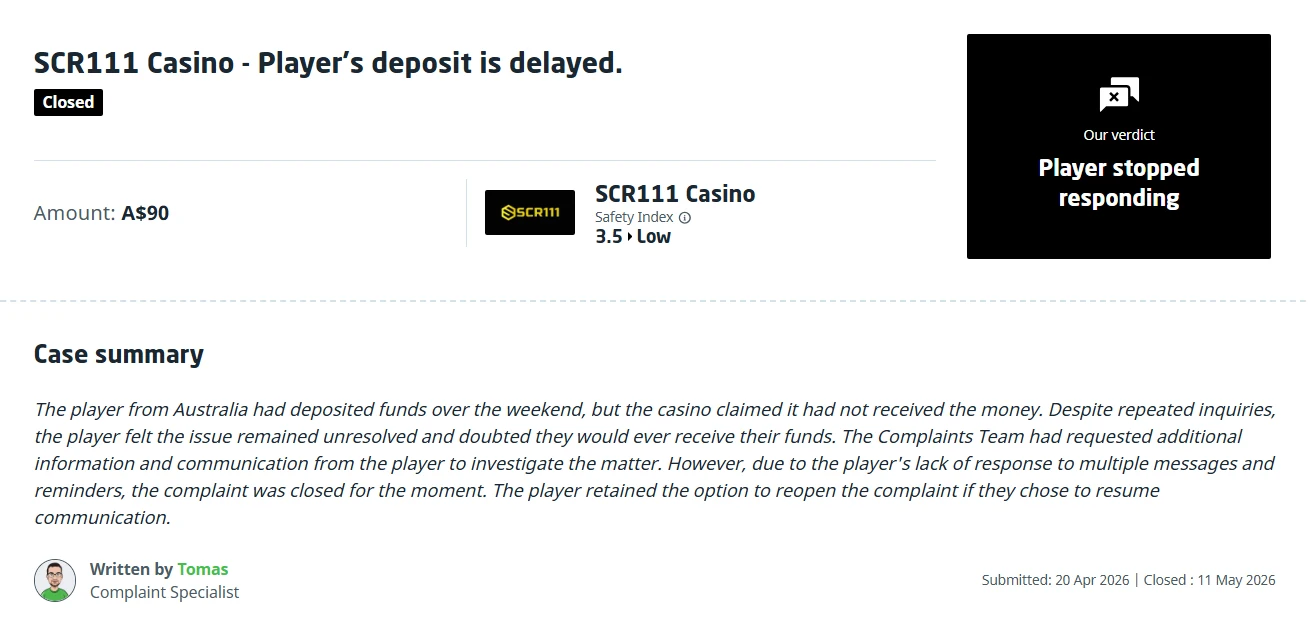
The clearest public complaint record available for SCR111 is a 2026 case from an Australian player involving a delayed A$90 deposit. The complaint was submitted on 20 April 2026 and closed on 11 May 2026 after the player stopped responding to the complaint mediator’s follow-up questions. The record therefore documents a reported deposit problem, but it does not establish why the deposit was delayed, whether SCR111 ultimately received the funds, or whether the same issue affects other players.
That distinction matters. A complaint is evidence that a person reported a problem. Its value depends on the chronology, supporting material, operator response, mediator findings and final status. One unresolved narrative should not be converted into a claim of systemic wrongdoing. At the current check, the same complaint database lists one SCR111 complaint in total, with no open, unresolved or resolved cases and one rejected/closed case. This page focuses on what that record can support, not on third-party scores or an overall label.
- The documented Australian complaint
- How to read a casino complaint without overinterpreting it
- Complaint count: what one public case does and does not mean
- Why the A$90 case belongs with payment research
- Reputation is broader than complaints
- A practical complaint-reading checklist
- What would strengthen or change the picture
- Practical reading: the public complaint record is narrow
The documented Australian complaint
The public case concerns an Australian player who said a weekend deposit had left their bank account while SCR111 said the funds had not been received. The disputed amount was A$90. The player expressed frustration that repeated contact had not resolved the issue and asked the complaint service for help. That is the allegation side of the record and should be read as the player’s account rather than as an independently proven finding.
The mediator then asked for information that would normally be important in a payment investigation: whether it was the player’s first deposit, which payment method had been used, a image of the payment instructions, and recent communication with the casino. The complaint service later extended the response period. After the player did not respond to the requests and reminders, the case was closed because the mediator could not continue the investigation. The record states that the player could ask to reopen the complaint later.
This outcome is materially different from a finding that the casino withheld the deposit. It is also different from a resolved complaint in which the missing money was confirmed as credited or refunded. The public evidence stops before either finding. For readers researching SCR111, the case is still useful because it identifies a real type of friction – a deposit that a player believed had left their bank but had not been credited – while also showing why incomplete evidence limits what can be concluded.
How to read a casino complaint without overinterpreting it
Complaint pages can look decisive because they contain strong first-person language, supporting images, ratings and a final status label. Those elements do not all carry the same evidentiary weight. A careful reading starts by separating what the player alleges from what an operator acknowledges, what a mediator verifies and what remains unanswered. That method is more informative than counting negative adjectives or treating a site’s reputation score as a substitute for the underlying file.
- Disputed amount: record the exact amount and currency. Here it is A$90, which helps define the scale of the reported issue but says nothing by itself about frequency.
- Chronology: note when the complaint was submitted, what questions were asked and when it closed. A timeline can show whether a case reached an evidence-gathering stage or ended before investigation was possible.
- Payment trail: distinguish a bank debit, merchant receipt, casino cashier entry and credited gaming balance. Those are separate steps in a transaction chain and may not happen at the same time.
- Operator response: check whether the casino supplied records, explanations or a remedy. In the published SCR111 case, the available record does not establish a completed operator-side resolution.
- Mediator finding: look for a reasoned finding rather than assuming that a closed or rejected label means the complaint was disproved. This case closed after the player stopped responding.
- Sample size: one complaint is one data point. It can identify a possible failure mode, but it cannot establish how often that event occurs across the player base.
The same approach applies to positive testimonials. A single successful cash-out or complimentary review does not prove that every withdrawal is prompt. Reputation research becomes more useful when individual reports are treated as case evidence rather than votes in a simple good-or-bad tally.
Complaint count: what one public case does and does not mean
At the current check, Casino Guru’s SCR111 review page lists one complaint in total: zero open, zero unresolved, zero resolved and one rejected/closed case. It also indicates that there is not enough user-review data for a broad feedback assessment. Those counts are useful for understanding the size of the public record on that platform, but they are not a complete census of every interaction between SCR111 and its players.
A low complaint count can have several possible explanations that the count itself cannot distinguish. A brand may have few problems, a smaller customer base, users who choose other dispute channels, or users who never publish their issue. Conversely, a large complaint count can reflect both more problems and a much larger customer population. Without a reliable denominator – such as verified active-player volume over the same period – complaint totals should not be converted into failure rates.
For SCR111, the evidence base is therefore narrow. The supported reading is not that the brand has a clean record or a bad record. It is that the publicly documented complaint sample we could verify is small and contains one Australian deposit-delay case that did not reach a fully investigated outcome.
Why the A$90 case belongs with payment research
The complaint is specifically about a deposit, so it should be read alongside the site’s payment evidence rather than treated as a general statement about every feature of SCR111. The payments and withdrawals separates verified payment-method information from details that could not be established, such as exact withdrawal limits, processing times and fees. That separation matters because payment reliability is not one single fact.
A deposit can fail or be delayed at several points: initiation in the banking app, routing through a payment provider, merchant recognition, reconciliation by the casino or crediting to the player’s gaming balance. A public complaint generally shows the player’s visible part of that chain. Unless transaction records from the relevant systems are available, it may be impossible to identify exactly where the delay occurred.
For a player facing a similar situation, useful records include the transaction reference, timestamp, amount, payment method, bank status, cashier instructions and support transcript. Keeping those items together makes it easier for both the operator and any independent mediator to compare the player’s bank record with the casino-side transaction log. It also reduces the risk that a complaint stalls because basic evidence is missing.
Reputation is broader than complaints
Complaint history is only one trust signal. Ownership transparency, licensing evidence, accessible terms, payment disclosures, support channels and responsible-gambling information all answer different questions. They should be checked separately so a weakness in one area is not silently turned into a claim about all the others.
The available public sources did not establish a reliably verified parent-company identity for SCR111. That is a transparency limitation in the evidence available to us, not proof of misconduct. Likewise, third-party material makes conflicting licence claims, but this site does not treat a foreign licence as valid without the level of regulator evidence required by the evidence standard used here. For the Australian position, see the Australian licence context, which explains what the ACMA register can and cannot establish.
This is also why third-party numerical ratings are not reproduced here as this site’s own judgment. A score usually combines several assumptions selected by the publisher: complaint weighting, licence quality, terms, withdrawal restrictions, company history and other factors. Those methodologies can be useful to inspect, but the score itself hides the underlying evidence. Readers can make a more informed assessment by looking directly at the records and deciding which factors matter to them.
A practical complaint-reading checklist
When you encounter a new SCR111 complaint, use a repeatable checklist before deciding what it adds to the evidence base. First, confirm that the case is actually about SCR111 and not a similarly named site. Next, identify the country, disputed amount, transaction type and dates. Read the full thread rather than only the headline. Note what evidence the player supplied, whether the operator replied, whether the mediator independently verified anything and why the case received its final status.
Then compare the complaint with the existing record. Is it a second instance of the same deposit problem, or a completely different issue? Does it involve the same payment rail, the same time period or the same support process? Repetition across genuinely independent cases can be more informative than one isolated report, but similarity alone still does not prove a common root cause.
Finally, record what remains unknown. A good evidence note should make uncertainty visible instead of filling it with assumptions. In the 2026 A$90 complaint, the key unknown is the final transaction outcome because the investigation stopped when the player no longer responded. That missing endpoint is central to interpreting the case correctly.
What would strengthen or change the picture
The reputation picture would become more informative if additional independent complaint records appeared with enough documentation to establish outcomes. Several fully investigated cases involving the same failure mode would be more significant than one incomplete case. An operator response containing transaction references or a documented refund could also clarify an individual dispute. Conversely, a reopened case that supplied the requested evidence could materially change the interpretation of the existing A$90 complaint.
Ownership and regulatory transparency could also improve if the operator publishes a legal entity that can be matched to authoritative company or regulator records. Until such evidence is available, this guide keeps those questions separate from the verified complaint facts instead of using missing information as a substitute for proof.
For the broader evidence framework, the trust and regulation overview explains how this site weighs regulator records, company transparency, complaints and service information. The SCR111 Australia review brings those findings together with games, account and payment information without turning a single complaint or third-party rating into a blanket judgement.
Practical reading: the public complaint record is narrow
The public evidence we could verify shows one 2026 complaint from an Australian player about a delayed A$90 deposit. It was closed after the player stopped responding to requests for more information, leaving the underlying payment outcome unestablished. The current complaint listing shows no open or unresolved SCR111 cases on that platform and a total sample of one.
That is enough to document that a deposit-delay complaint occurred. It is not enough to conclude that SCR111 routinely fails to credit deposits, nor is it enough to conclude that payment problems never occur. The useful approach is to keep the case in proportion, preserve the distinction between allegation and finding, and update the assessment if better evidence or additional fully documented cases emerge.
Written by the editors at Scr111 Casino.