SCR111 Trust and Regulation: Evidence, Licensing Signals and Player Checks
 Available in AU
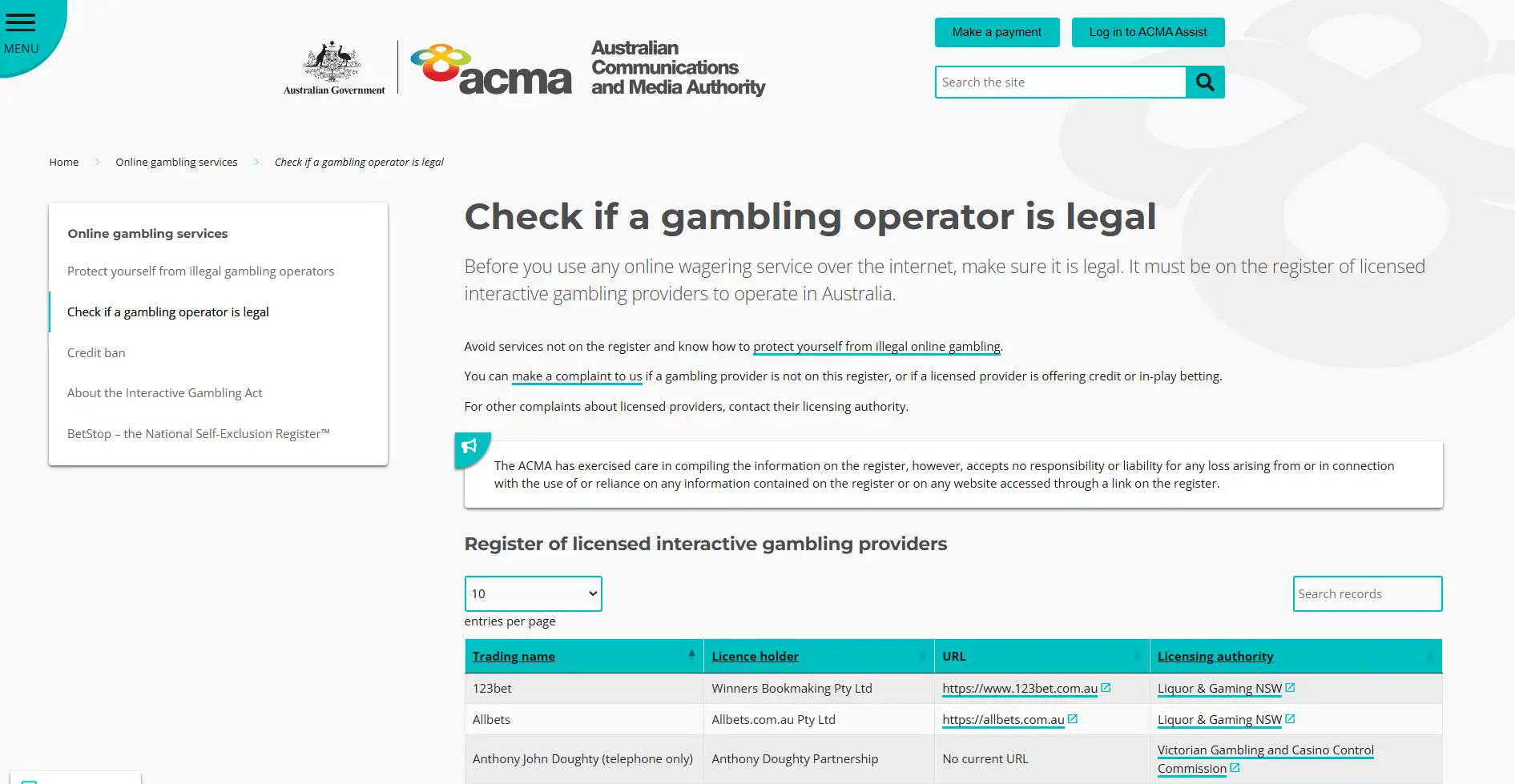
For an Australian reader, the most useful way to assess SCR111 is to separate facts that can be checked from opinions that cannot. The current ACMA register of licensed interactive gambling providers does not list SCR111, so this site does not describe SCR111 as holding an Australian licence. Australian law also treats online casino services as prohibited interactive gambling services when providers offer them to people in Australia. Those are regulatory facts about authorisation and provider conduct, not a complete assessment of every other aspect of the site.
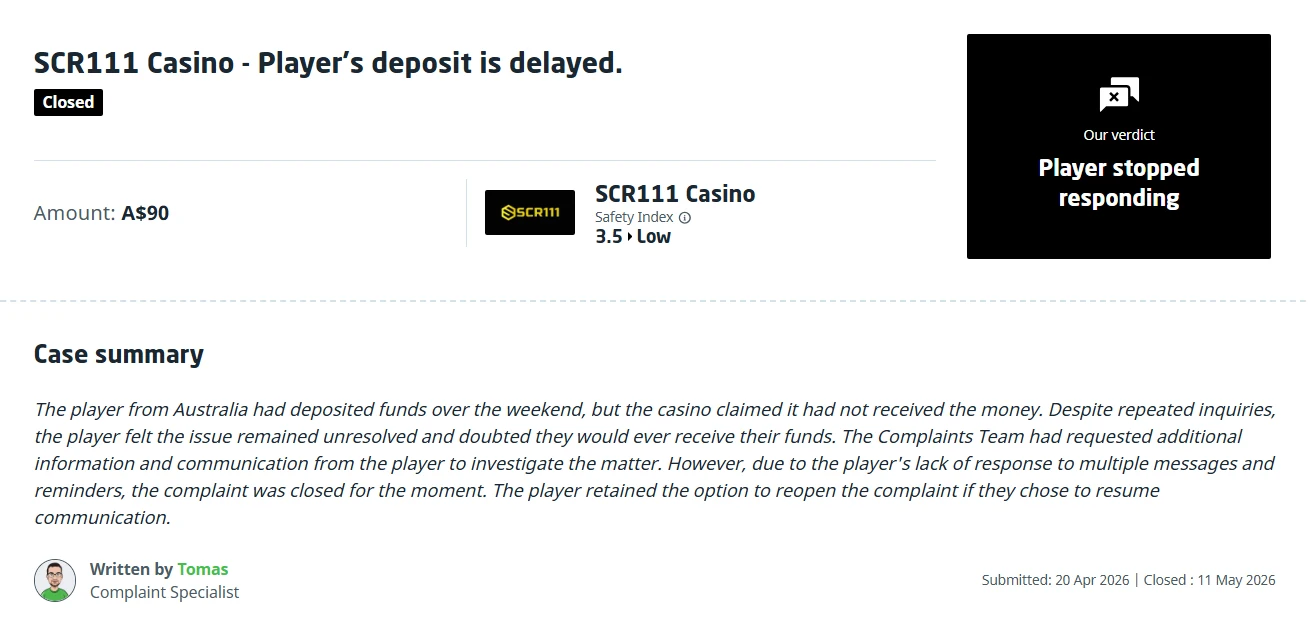
The available evidence also does not verify a reliable parent-company identity for SCR111. One public 2026 complaint from an Australian player concerned a delayed A$90 deposit and was later closed after the player stopped responding. That complaint is useful as a documented service event, but it is not proof of a general pattern. For legal detail, see the Australian licence and law guide. For complaint context, see public complaint evidence.

- A practical evidence hierarchy for SCR111
- What the ACMA register does and does not tell you
- Company identity and terms transparency
- How to read complaint evidence without overreacting
- Why third-party ratings are not the same as evidence
- Support quality is a separate trust signal
- Responsible gambling resources and the limits of BetStop
- A five-step check before relying on SCR111
- Current Australian enforcement context
- Documenting a check so it can be repeated
- Practical reading: use the strongest source for each question
A practical evidence hierarchy for SCR111
Trust questions often collapse several different issues into one label: licence status, company transparency, payment reliability, support quality, dispute history and safer-gambling controls. They should not be treated as interchangeable. A licence can tell you which regulator has authority over an operator. It does not automatically prove that every payment will be fast. A complaint can reveal a specific service failure or misunderstanding. It does not automatically establish a systemic problem. A slick website can make information easy to find. It does not replace a regulator entry or verifiable company record.
For SCR111, the strongest Australian evidence starts with the Australian Communications and Media Authority. ACMA maintains the public register used to check licensed interactive wagering providers and explains the federal Interactive Gambling Act framework. SCR111 does not appear on the current register. That means an Australian licence claim should not be made for this brand. It also means Australian consumer protections that depend on being within the local licensed wagering framework should not be assumed to apply to SCR111.
The next level is operator transparency: who runs the site, what entity appears in the terms, which jurisdiction is named and whether that information can be matched to an authoritative register. The current available evidence does not provide a reliably verified parent company for SCR111. Because the evidence standard here is deliberately strict, this guide does not fill that gap with guesses from domain records, forum posts or unattributed review text.
What the ACMA register does and does not tell you
ACMA’s register is an important starting point, but its scope matters. It is a register of licensed interactive gambling providers operating within Australia’s regulated interactive wagering framework. It is not a global directory of every gambling company. A brand being absent from the register supports a precise statement: no Australian local licence is verified through that register. It should not be stretched into a claim about an overseas licence unless the relevant overseas regulator has been checked separately.
That distinction matters for SCR111 because third-party material is not enough to establish a foreign licence number, expiry date or regulatory status. This review therefore does not publish a Curaçao, PAGCOR or other foreign licence as verified unless an authoritative regulator-level source supports it. A logo in a footer, a badge on a review page or a repeated claim across affiliate sites is not a substitute for regulator evidence where licence validity is the question.
For readers who want the legal framework rather than the trust overview, the ACMA licence status page explains the provider-side rules, what online casino prohibition means under the Interactive Gambling Act, and why operational access is not the same thing as Australian regulatory authorisation.
Company identity and terms transparency
A useful trust check is whether the operator identity is clearly and consistently disclosed. Look for a legal entity name in the terms, privacy documentation and payment conditions, then check whether the same entity appears in any regulator record that is being claimed. Consistency matters more than the visual polish of a badge or logo. If different pages name different entities, or if no entity can be verified, treat that as an information gap rather than solving it with speculation.
For SCR111, the available evidence does not verify a reliable parent-company identity. That does not prove a hidden or improper ownership structure. It simply limits what can responsibly be said. This site therefore avoids inventing an operator name, office, company registration number or corporate history. If the brand later publishes clearer legal-entity information that can be matched to an authoritative source, that evidence can be reassessed.
Terms transparency is also practical rather than abstract. Before relying on a promotion, payment method or account feature, compare the current wording in the cashier and terms with the summary you are reading. The payments evidence separates confirmed Australian-facing payment facts from withdrawal details that were not safely verified.
How to read complaint evidence without overreacting
The available evidence includes one documented 2026 Casino Guru complaint from an Australian player involving a delayed A$90 deposit. The case was closed after the player stopped responding. That is a concrete event worth recording because it shows the kind of payment issue a user may encounter and how the public complaint process unfolded. It is not enough, by itself, to prove a broad pattern of non-payment, fraud or reliable resolution.
A better complaint check looks at several dimensions: the issue type, the amount, whether the operator responded, whether the player supplied requested information, whether the complaint reached a verified resolution, and whether similar cases recur. Complaints also need date context. Several recent unresolved withdrawal complaints would tell you something different from an isolated older deposit delay.
Our complaints and reputation page keeps that chronology separate from the legal analysis. The purpose is to help readers inspect evidence, not to convert one incident or a third-party rating into this site’s own score.
Why third-party ratings are not the same as evidence
Casino review sites often publish safety indexes, star ratings, trust scores or recommended lists. Those tools can point you toward issues to investigate, but they mix factual inputs with each publisher’s methodology. One site may weight unresolved complaints heavily, another may emphasise licence jurisdiction, and another may reward the size of a game catalogue or bonus package. Repeating the final score would import somebody else’s judgment without importing the full method.
This guide instead uses third-party sources for concrete facts when they support a specific claim, such as a documented feature or complaint record. It does not reproduce a review site’s overall rating as an objective fact. Where a claim is especially sensitive – such as a licence number, expiry date, exact withdrawal limit, exact processing time or exact KYC requirement – the evidence standard should be higher, and the specific value is omitted if a suitable primary source cannot be checked.
Support quality is a separate trust signal
Support matters because many gambling disputes begin as ordinary account or payment questions. A useful support assessment asks whether there is a reachable channel, whether answers are specific, whether the agent can identify the relevant term, and whether the conversation can be documented. Save timestamps, transaction references and copies of messages when a payment or verification issue is involved.
Support availability should not be confused with regulatory recourse. A responsive live-chat agent can help resolve a practical issue, but a local licence determines access to specific Australian regulatory protections and complaint pathways. Because SCR111 is not shown on the current ACMA licensed-provider register, this site does not imply that the brand participates in local schemes that apply to Australian licensed wagering providers.
Responsible gambling resources and the limits of BetStop
Australian public-health guidance treats gambling harm as a significant health and social issue, including financial, mental-health and relationship impacts. A trust review should therefore consider whether readers can identify practical ways to limit or stop gambling, not only whether a site has a large game library.
BetStop is Australia’s National Self-Exclusion Register for Australian licensed online and phone wagering providers. Its scope should be stated accurately. It should not be presented as if it automatically blocks access to every offshore online casino. If a person wants to reduce gambling access more broadly, device-level blocking tools, bank gambling blocks where available and support services can complement formal self-exclusion arrangements.
This is another reason to keep regulatory categories clear. Licensed wagering, prohibited online casino services and offshore availability are different questions. Combining them into a single “safe” or “unsafe” label removes useful detail.
A five-step check before relying on SCR111
- Check Australian authorisation. Search the current ACMA licensed-provider register rather than relying on a badge or review claim. For SCR111, no Australian licence is verified in that register.
- Check the operator identity. Compare the entity named in terms, privacy and payment pages. Do not assume a parent company when the available evidence does not verify one.
- Check the exact transaction rule. For deposits and withdrawals, read the cashier and current terms for the method you intend to use. Our payment methods page explains what is verified and what remains unspecified.
- Check complaint details, not just a score. Look at dates, amounts, issue types, responses and resolution status. An isolated complaint and a repeated unresolved pattern should not be treated as equivalent.
- Decide your own limits before playing. Set a fixed entertainment budget and stop conditions in advance. If gambling is no longer recreational, use Australian support resources and blocking options rather than trying to recover losses.
Current Australian enforcement context
ACMA actively investigates and takes action against illegal online gambling services targeting Australia, including requesting internet service providers to block sites. The existence of that enforcement program is relevant context for any offshore casino review. It does not, by itself, prove that SCR111 has been specifically blocked, and this page does not make that claim.
Australia also passed a package of gambling reforms in August 2026, with most measures scheduled to commence on 1 January 2027. ACMA describes changes including tighter advertising controls, stronger enforcement tools and changes connected with BetStop. Because these rules are time-sensitive, readers should use the regulator’s current guidance when checking the position after that commencement date.
Documenting a check so it can be repeated
A useful trust check should be repeatable by another reader. Record the date of the check, the exact regulator or terms page used, the entity or trading name searched, and what the source actually showed. That prevents an old saved image, a renamed brand or an affiliate summary from being mistaken for current evidence. It also helps separate a genuine change in status from a difference in wording between publishers.
For sensitive details, keep the evidence standard proportionate to the claim. A licence number should trace to a regulator or operator licence page. A precise withdrawal limit should trace to current payment terms. An exact KYC document list should trace to the operator’s verification instructions. When that source is missing, the responsible choice is to omit the number or list rather than substitute a common industry practice.
Practical reading: use the strongest source for each question
The clearest current picture is not a single score. SCR111 is not listed on ACMA’s licensed interactive gambling provider register. The available evidence does not verify a reliable parent-company identity. A single Australian deposit-delay complaint is documented, but its closure does not establish a broader pattern. Foreign licence claims are not treated as verified here without regulator-level evidence.
Those points are best used as a set of checks rather than a single label. For statutory context, continue to Australian licence and law. For public dispute history, use the complaints and reputation guide. For the wider product picture, return to the full SCR111 review.
Published by the Scr111 Casino team.